
Ultrawall guide
Garage Pegboard: Hole Sizes, Hooks, Layout and Load
How to plan a steel pegboard wall: 1/8 or 1/4 inch hooks, panel sizes and price per square foot, studs and anchors, layout by job, kits compared and what the load ratings mean.
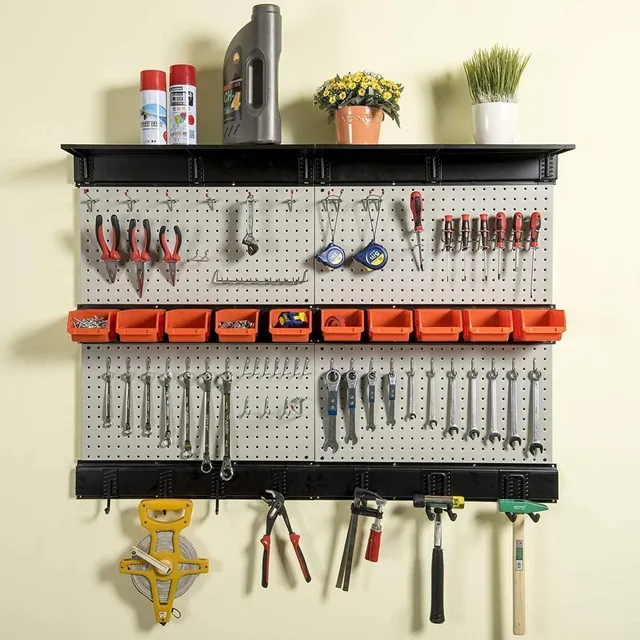
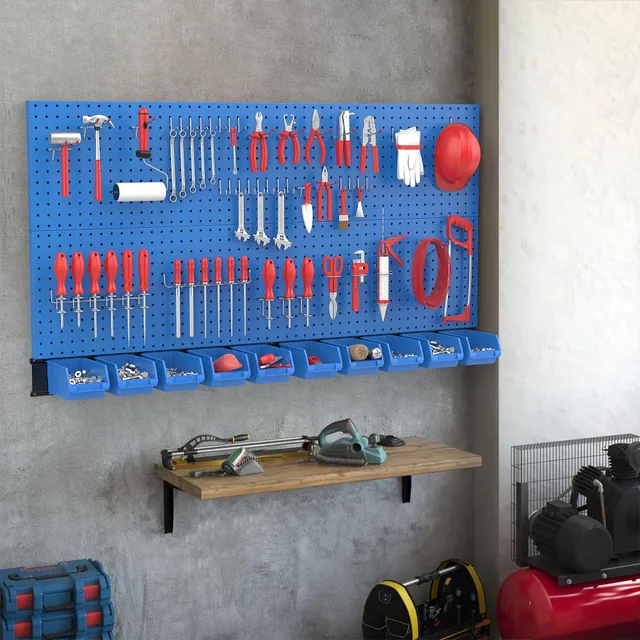
A pegboard wall is the cheapest way to see every tool you own at once. Hang a hammer on a hook and it stays where your hand expects it, the outline of the empty hook tells you what is missing, and the bench under it stays clear. The idea is old. What changed is the board. Ours are steel, powder-coated, and punched to take two sizes of hook, and that changes how you plan, mount and load the wall.
- 2hook wire sizes our panels take
- 1 inhole spacing our hook sets fit
- 8steel pegboard designs
We make 3 lines of plain steel panels and 5 complete pegboard kits, plus hook sets and rail bins. This guide follows the questions buyers ask most, in the order you will meet them: the holes, the panel sizes, the wall, the layout, the hooks, the weight, and the small parts that end up in bins.
Start with the holes: 1/8 inch or 1/4 inch
Pegboard hooks come in two wire sizes. Hooks for 1/8 inch boards are thinner and lighter. Hooks for 1/4 inch boards are thicker and carry more before they bend. A board punched for 1/4 inch hooks lets the thin hooks wobble, and a board punched for 1/8 inch hooks will not take the thick ones at all.
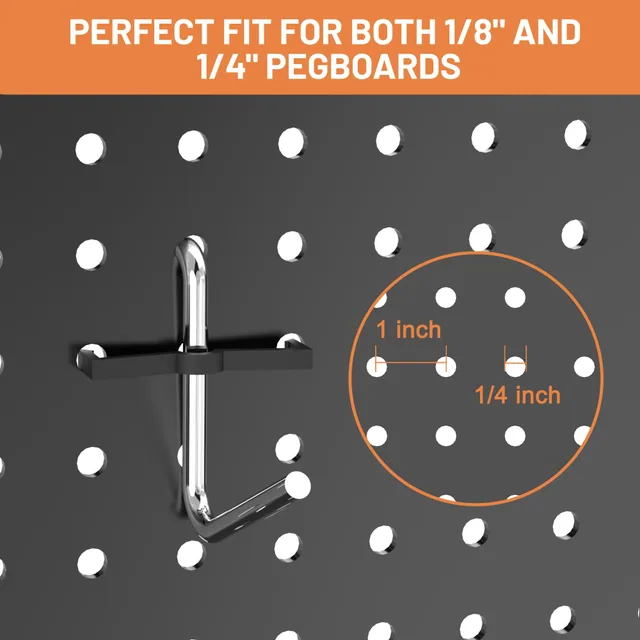
Our steel panels take both. That matters most if you already own a coffee can of old hooks: you do not have to sort them before you hang the new wall. Our hook sets are made for 1/8 inch and 1/4 inch boards with holes 1 inch apart.
If you already have a board on the wall, measure two things before you order hooks: the hole size and the distance between hole centers. A tape measure across ten holes gives you the spacing quickly. If the ten gaps measure 10 inches, you are on 1 inch spacing and our hooks will line up.
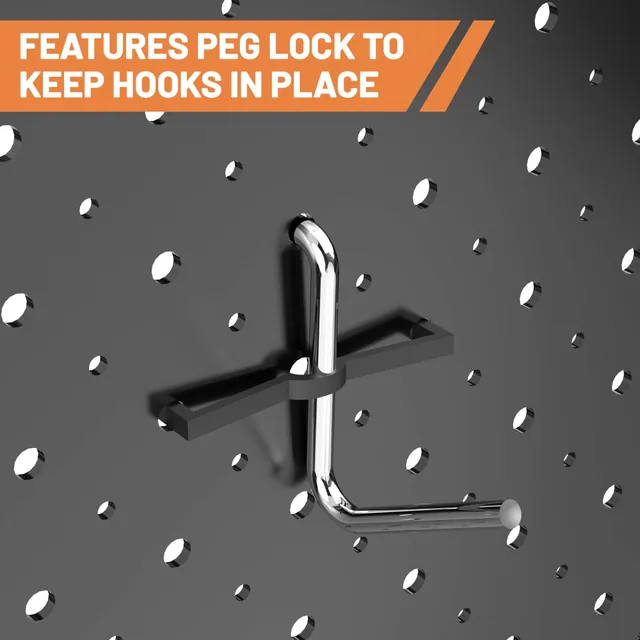
One more detail sounds small and is not. A hook that sits loose in a hole lifts out when you pull a tool off it. It is the most familiar annoyance of pegboard. Our hook sets come with peg locks, small plastic clips that snap over the hook so it stays put when you grab the wrench in a hurry. Use them on the hooks you reach for every day, and leave them off the ones you move around.
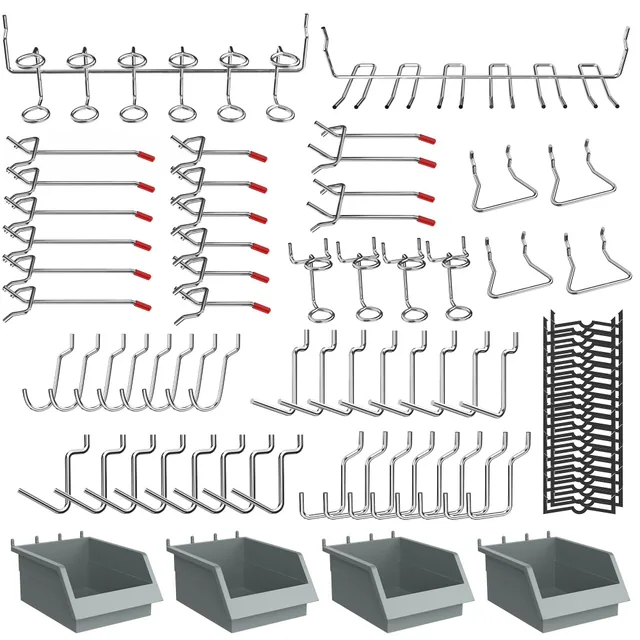
Ultrawall Pegboard Hook Set with Bins
120–210 pieces in a dozen shapes, with peg locks, for 1/8 and 1/4 inch boards on 1 inch spacing.
Panel sizes and how many you need
Our plain panels come in three lines. Two of them are 24 by 12 inches, two square feet per panel: one in packs of two and four, the other in a pack of three in gray, white or black. A 16 by 12 inch panel, about one and a third square feet, fits narrow gaps such as the space between two cabinets or the inside of a shed door.
Count the wall in panels, not in square feet. Stand where you work, stretch both arms out, and mark the reach on the wall. For many people that is four to five feet wide.
- 2 sq ftper 24 × 12 in panel
- 1.33 sq ftper 16 × 12 in panel
- 12 sq fton the 48 × 36 in kit board
Then decide how high the wall should go. A board that starts at the bench top and ends at the height you can reach without a step stool is usually two to three feet tall. A four-foot by two-foot wall takes four 24 by 12 inch panels set two across and two high. A four-foot by three-foot wall takes six.
Price per square foot is the honest way to compare packs, because the packs differ in both count and size. The table works it out from the current price of every pack and color we sell. It changes when the prices do, so read it as a ranking, not a quote.
| Point | Panels | Pack | Area | Price | Per sq ft |
|---|---|---|---|---|---|
| Metal Pegboard Panels, 24 × 12 in | 4 panels, Black | 8 sq ft | $49.99 | $6.25 | |
| Metal Pegboard Panels, 3 Pack | 3 panels, Gray | 6 sq ft | $42.99 | $7.17 | |
| Metal Pegboard Panels, 3 Pack | 3 panels, White | 6 sq ft | $42.99 | $7.17 | |
| Metal Pegboard Panels, 3 Pack | 3 panels, Black | 6 sq ft | $42.99 | $7.17 | |
| Metal Pegboard Panels, 24 × 12 in | 4 panels, Gray | 8 sq ft | $59.99 | $7.50 | |
| Metal Pegboard Panels, 16 × 12 in | 4 panels, Black | 5.3 sq ft | $42.99 | $8.06 | |
| Metal Pegboard Panels, 16 × 12 in | 4 panels, Gray | 5.3 sq ft | $42.99 | $8.06 | |
| Metal Pegboard Panels, 16 × 12 in | 2 panels, Gray | 2.7 sq ft | $23.74 | $8.90 | |
| Metal Pegboard Panels, 24 × 12 in | 2 panels, Black | 4 sq ft | $39.99 | $10.00 | |
| Metal Pegboard Panels, 24 × 12 in | 2 panels, Gray | 4 sq ft | $39.99 | $10.00 | |
| Metal Pegboard Panels, 16 × 12 in | 2 panels, Black | 2.7 sq ft | $29.99 | $11.25 |
Right now the cheapest square foot is the Metal Pegboard Panels, 24 × 12 in in the 4-panel pack in black, at $6.25, and the dearest is the Metal Pegboard Panels, 16 × 12 in in the 2-panel pack at $11.25. Bigger packs usually win, but not always, and colors are priced separately. If the wall is large, the four-packs of 24 inch panels tend to come out ahead.
What is behind the wall, and how to fasten to it
A pegboard wall is only as strong as what holds it to the house. In many garages that is a wall of wood studs behind half-inch drywall, with the studs 16 inches apart. Some garages have concrete block or poured concrete walls. Older ones have brick. Each needs a different fastener, and the box tells you which ones it contains.
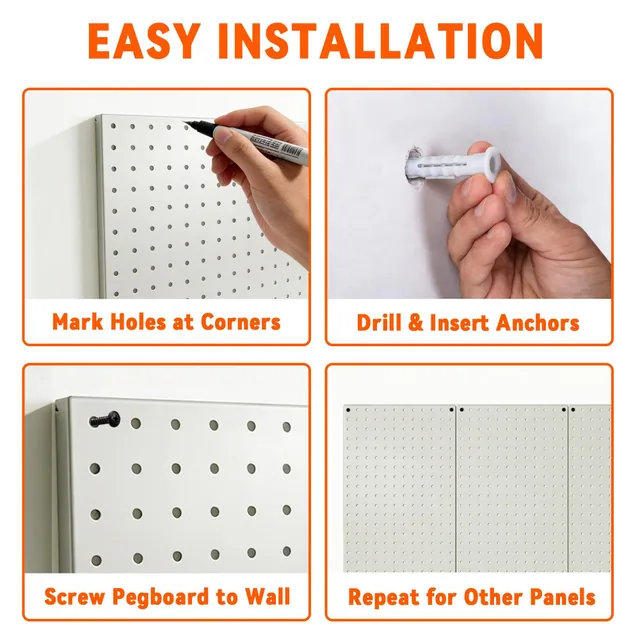
Our plain panels ship with screws and expansion tubes for drywall, brick and concrete walls. Several of our rail kits are stricter: the 64 inch tool rack and the 48 inch organizer say plainly that the hardware in the box is for wood studs and drywall only, and that concrete or brick needs the right masonry anchors. Plastic drywall anchors are not made for brick or concrete.
Find the studs before you mark anything. A stud finder is the easy way. A strong magnet that sticks to the drywall screws works too. Mark the center of each stud with a pencil line from the floor up to the height of the top panel.
- 16 instud spacing our rails are made for
- 4corner fixings per panel
- 3wall types named for the panels
Then hold the first panel level, with a helper or a strip of painter’s tape, and mark its corner holes. Our install card shows four steps: mark the corner holes, drill and push in the anchors, screw the panel to the wall, then repeat for the next panel.
Where a corner hole lands on a stud, drive the screw into the wood and skip the anchor. Where it lands between studs, use the anchor. A panel with two screws in wood and two in anchors is far steadier than one with four anchors in drywall alone. If you have the choice of moving the whole board a few inches left or right to catch more studs, take it.
Hang the panels as their own instructions describe, and keep the load within the rating for that set. A pegboard rating assumes a sound wall and fasteners that suit it.
Tools for the job
Hanging a board takes a short list of tools, and having them out before you start halves the time. You need a stud finder or a magnet, a pencil, a 4 foot level or a laser line, a drill with a bit to match the anchors in the box, a screwdriver bit, and a tape measure. A second person to hold the panel level while you mark it is worth more than any tool on the list.
Pre-drill every hole, even into studs. A screw driven straight into a stud without a pilot hole can split the wood near its edge, and a split stud holds less. Set the drill clutch low for the last turns, so the screw heads pull the panel snug to the wall without crushing the drywall behind it.
Plan the layout before the first hook goes in
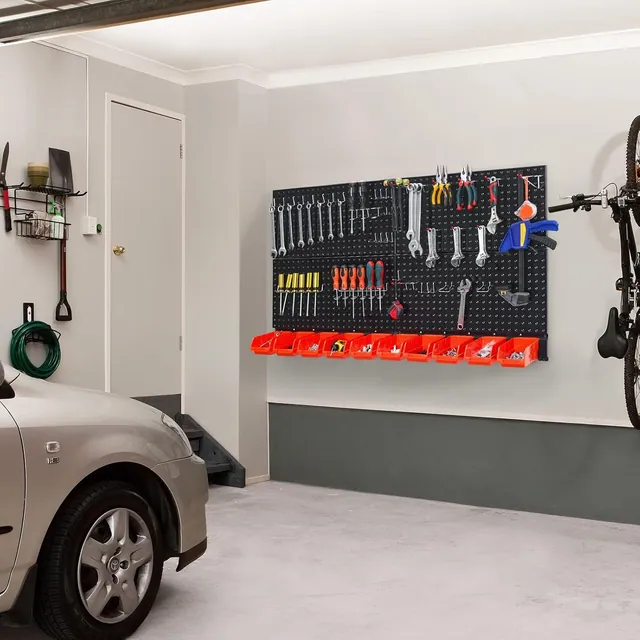
The best layouts start on the floor, not on the wall. Lay the panels on the garage floor, put your tools on them roughly where they will hang, and step back. You will see at once that the hammers are too far from the nails, or that the long level needs a whole row to itself. Moving a tool on the floor takes a second. Moving a hook on the wall takes a minute, and you will do it a dozen times.
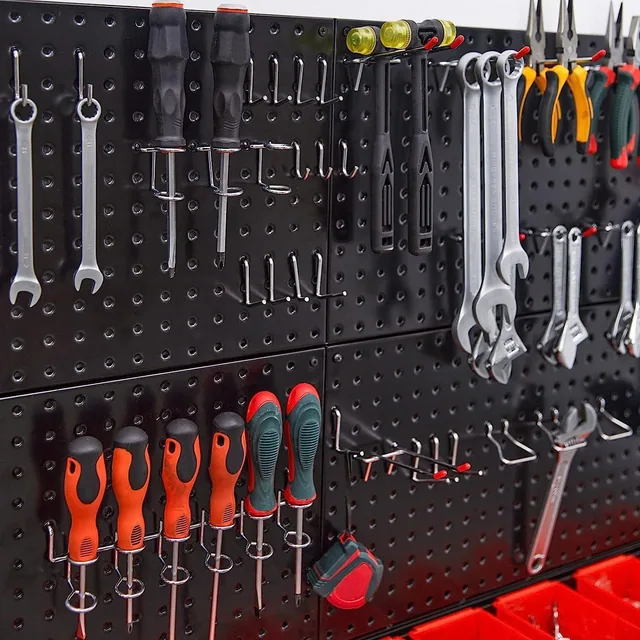
Group tools by job rather than by type. A painting group holds the brushes, the rollers, the scraper and the tape. A plumbing group holds the pipe wrench, the tubing cutter and the thread tape. That way one trip to the wall gets you everything a job needs. Put the groups you use weekly between waist and shoulder height, and push the rest to the edges and the top row.
Heavy tools go low and close to a stud line. A cordless drill, a grinder or a box of drill bits loads a hook harder than a screwdriver does, and the board flexes least where a screw goes into wood behind it. Light things, such as tape, gloves and pencils, can live anywhere.
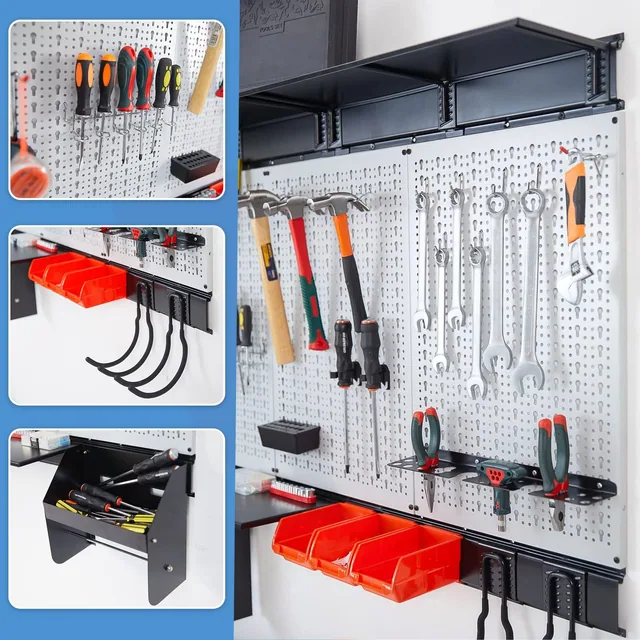
Leave space. A board packed edge to edge on day one has no room for the tool you buy next month. It is easier to add a panel to the side of a wall than to rearrange everything on it.
Trace outlines if you share the garage. A marker line around each tool shows where it belongs and makes the empty spot obvious when someone forgets to put it back. On steel panels, painter’s tape or a paint pen works better than a felt marker, and both come off later with a little solvent.
Which hooks do what
Hook sets look like a jumble in the box. Sorted, they fall into a few families, and each family has a job.
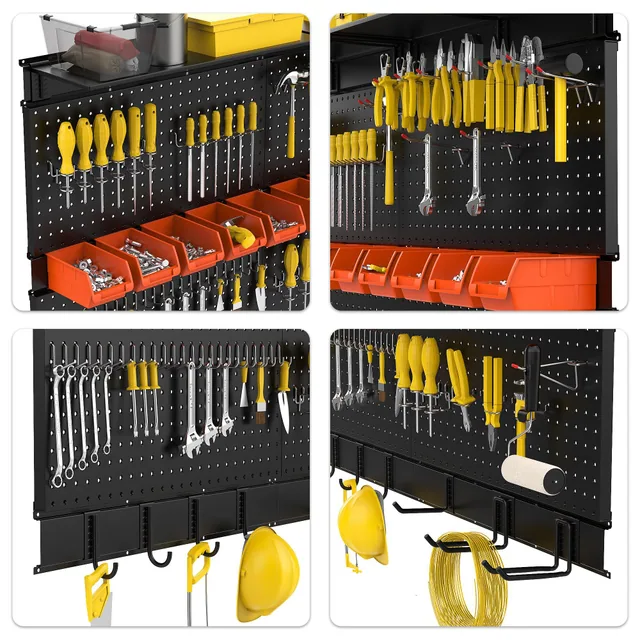
Straight hooks, single or double, take tools with a hole or a loop: wrenches, scissors, tape measures with a belt clip. Curved and angled hooks cradle tools that would slide off a straight one, such as hammers and pliers. J hooks and large U hooks take coiled cords, garden hose and extension cords. Tool racks, the flat bars with a row of slots, hold screwdrivers and Allen keys upright.
Bins clip on for loose parts.
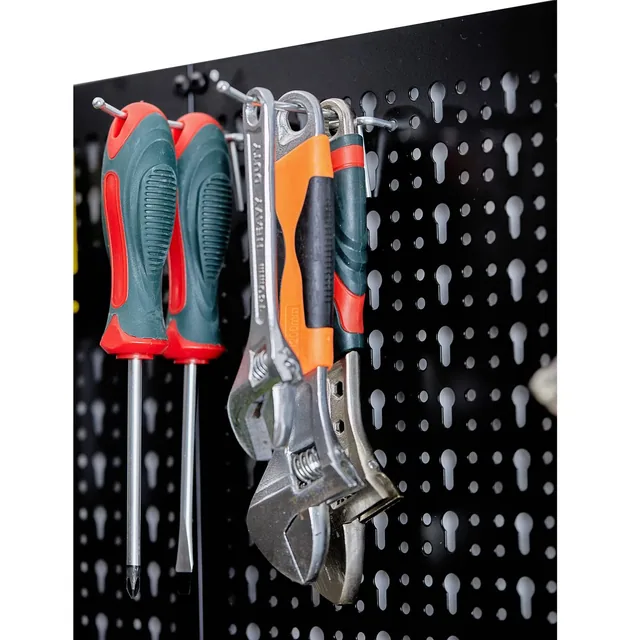
Start with more straight hooks than you think you need, a handful of curved ones, and two or three large hooks for cords. The hook set comes in 120–210 pieces in twelve styles, which covers most first walls with hooks to spare.
Watch the weight on single hooks. Our hook set has a recommended maximum of 10 pounds. That is plenty for hand tools, and it is the reason a heavy drill belongs on a shelf or a rail hook, not on a thin pegboard hook.
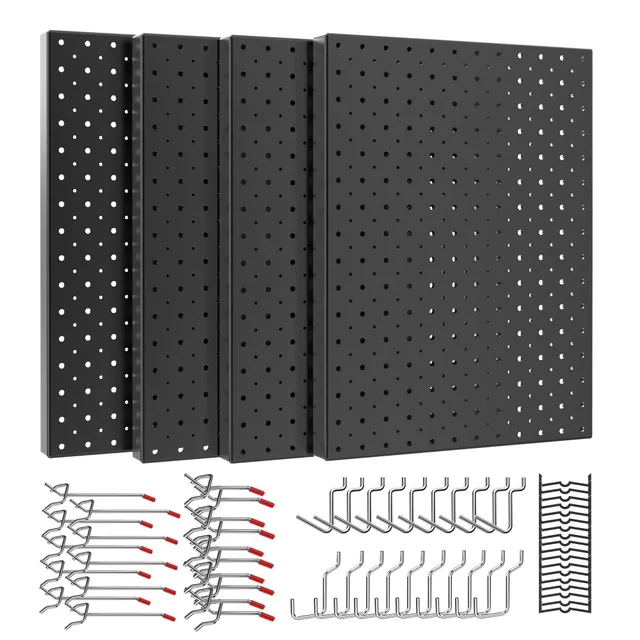
Ultrawall Pegboard Panels with Hooks, 4 Pack
Four black panels with about 80 hooks of mixed shapes, if you would rather buy the board and the hooks together.
Full kits compared
A full kit saves the planning and the separate orders. Ours put panels, rails, shelves, bins and hooks in one box. They differ in size, in how many pieces they carry, and in the load rating for the finished wall.
| Point | Kit | Board | Pieces | Price |
|---|---|---|---|---|
| 48 × 36 in Pegboard Wall Organizer | 48 × 36 in | 72 | $119.99 | |
| 48 × 36 in Pegboard Organizer | 48 × 36 in | 105 | $119.99 | |
| Pegboard Wall Organizer with Bins | 48 × 28 in | 59 | $79.99 | |
| 4 ft Metal Pegboard Kit | 48 × 24 in | 45 | $59.99 | |
| Pegboard Panels with Hooks, 4 Pack | 24 × 12 in | 74–84 | from $47.49 |
The 48 × 36 in Pegboard Wall Organizer is the most complete. Four panels make a 48 by 36 inch board, six steel rails carry the heavier hooks and two shelves, and ten bins and 43 mini hooks fill in the rest. The finished wall is rated to 1,200 pounds, which is a figure for the whole board fastened as the guide shows, not for any one hook.
The 48 × 36 in Pegboard Organizer has three panels, four rails, two overhead shelves, a small shelf and a paper towel shelf. Its rating is 200 pounds in total.
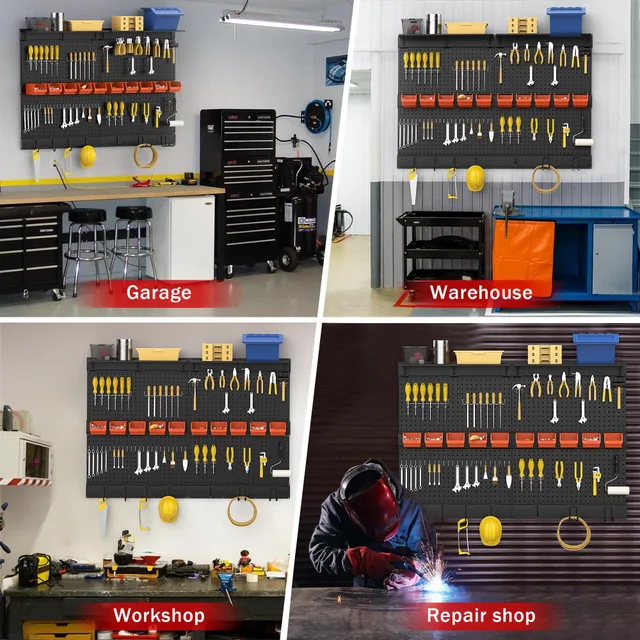
The Pegboard Wall Organizer with Bins is lower, at 48 by 28 inches, and comes in black or blue with ten orange bins. The 4 ft Metal Pegboard Kit is the plainest: a 4 foot by 2 foot gray board with 45 accessories, mostly hooks. If the wall above your bench is four feet wide, either of the larger kits fills it. If the bench is shorter, start with plain panels and a hook set and grow sideways.
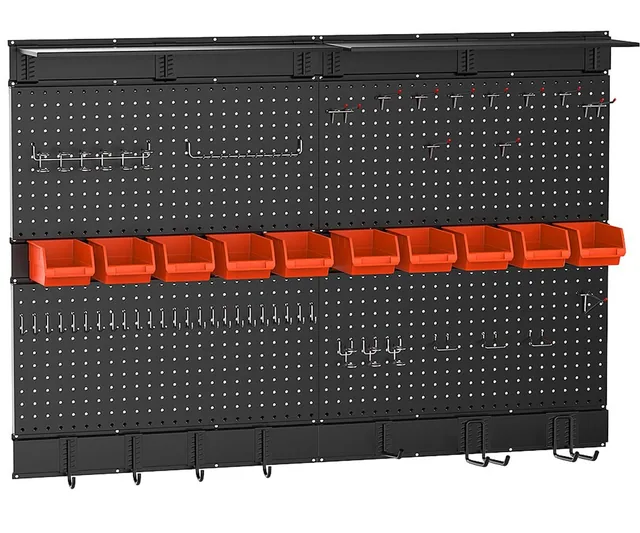
Ultrawall 48 × 36 in Pegboard Wall Organizer, 72 Pieces
Four panels, six rails, two shelves, ten bins and 50 hooks for a finished 48 by 36 inch wall.
When a rail beats a pegboard
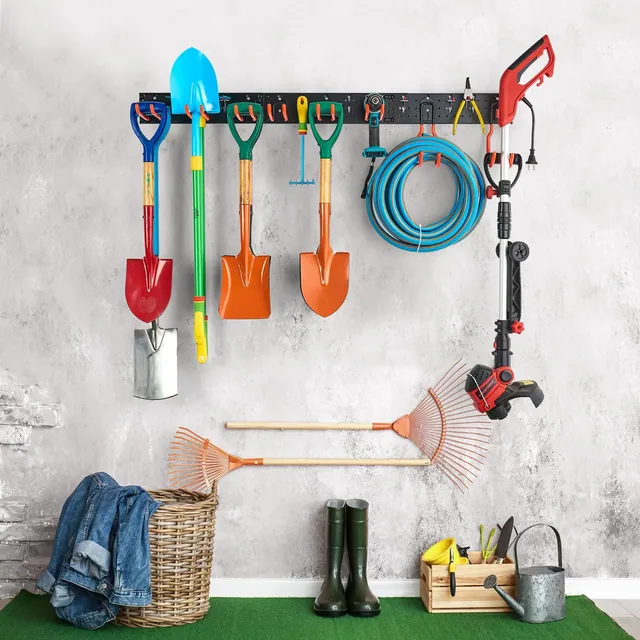
Pegboard is at its best with hand tools. Long-handled tools, such as rakes, shovels and brooms, want something else. Their weight sits at the end of a long lever, and a thin pegboard hook bends under it. A steel rail with heavy hooks spreads that weight into the studs through the rail itself.
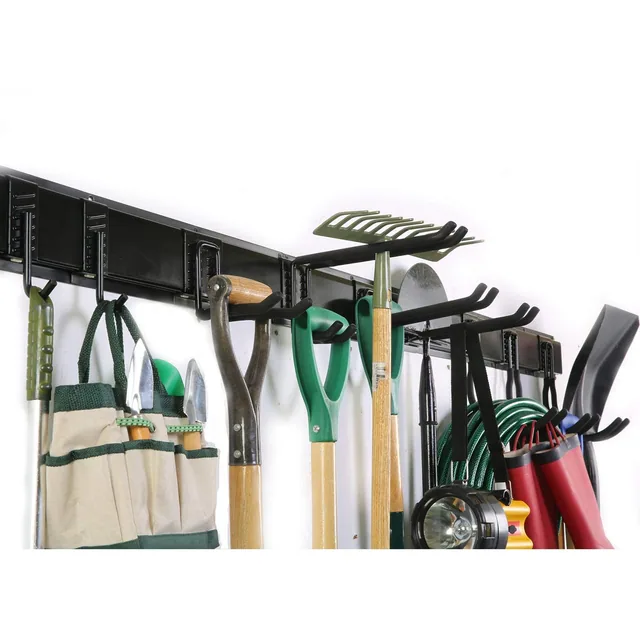
For that reason several of our kits include rails above or below the panels, and why we sell rail systems on their own. The 64 inch adjustable rack lines up four 16 inch rails with nine hooks that snap on and slide. The Multi-Storage Garage Hooks goes one step further: its rails are punched with pegboard holes along their face, so small pegboard hooks fit between the big ones, and the rack is rated to 300 pounds.
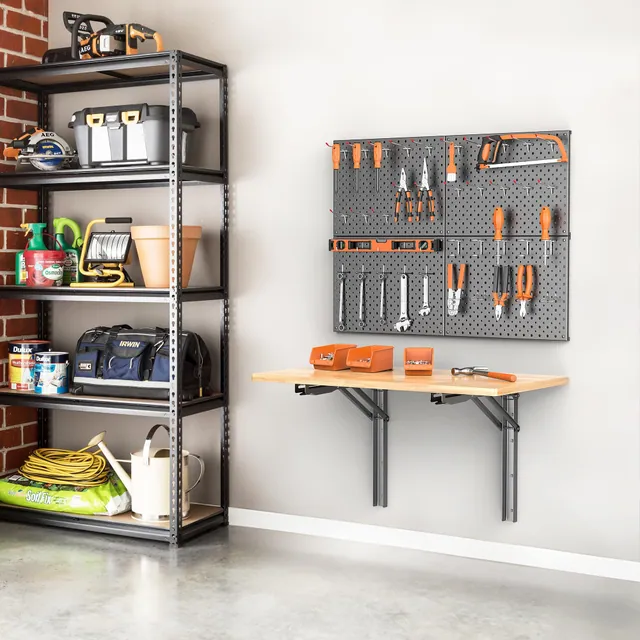
A common plan is a band of pegboard at bench height for hand tools, with a rail above it, near the top of your reach, for the long-handled garden tools. The rail goes high because those tools are tall, and the handles then hang down past the pegboard without covering it.
Bins for the small stuff
Every garage collects screws, nails, wall anchors, wire nuts and the spare parts of furniture you no longer own. They end up in coffee cans and jars. Bins on the wall make them visible and keep them off the bench.
Our rail bins hang on their own steel rails, four bins to a rail, and lift off so you can carry the screws to the job and hang the bin back. The smaller set has 12 bins on three rails, the larger one 16 bins on four rails, and every bin is rated to 22 pounds. They come in blue or orange. Some people use one color for fasteners and the other for electrical parts.
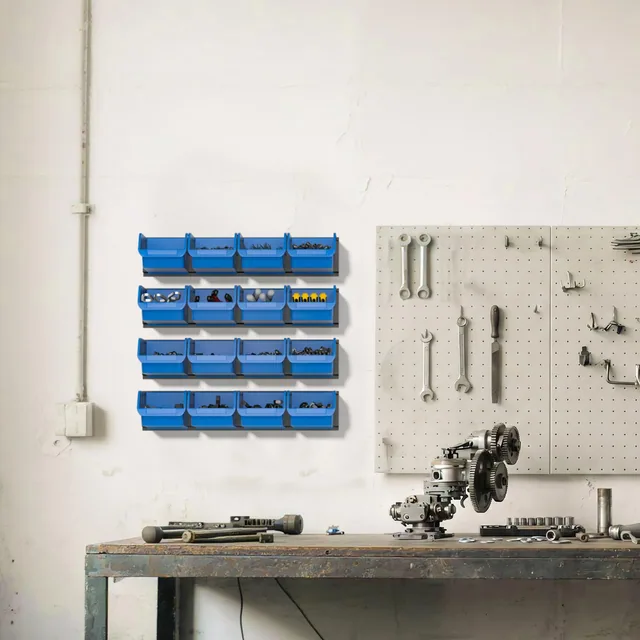
Put bins lower than tools. A bin above eye level is a bin you cannot see into. Between the bench top and your chin is the right band, and a label on the front of each bin saves more time than any other single thing on the wall.
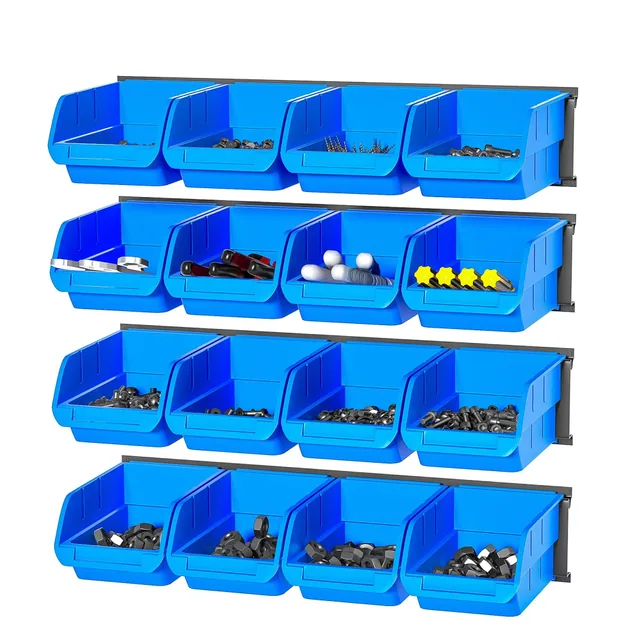
Ultrawall Wall-Mounted Storage Bins, 16 Bins
Sixteen lift-off bins on four steel rails, each bin rated to 22 pounds.
How much weight a pegboard wall really holds
Ratings on pegboard kits are easy to misread. A rating of 1,200 pounds on a wall describes the whole board, with every fastener in place, and with the load spread across it. It is not saying a single hook holds that much, and it is not saying the wall behind it can take that much on a few anchors in drywall.
Think of the load in three layers. The first layer is the hook, which is the weakest part. The second is the panel, which spreads what the hooks carry. The third is the wall and its fasteners, which carry everything. The wall fails when the third layer is the weak one, so the studs matter more than the steel.
- 1,200 lbthe 72-piece wall, in total
- 200 lbthe 105-piece wall, in total
- 10 lbweight recommendation for the hook set
In practice, a wall of hand tools weighs far less than any of these ratings. The things that push a board toward its limit are the heavy ones: a box of nails on a small shelf, a chain saw on a hook, a full toolbox on a bracket. Give those their own home on a shelf or a rail, and the pegboard will look after the rest.
A worked example: one bench, one wall
- 4panels of 24 × 12 in
- 8 sq ftof board
- 4 ftof bench below it
Numbers make the plan concrete, so here is one wall priced from our own range. The bench is 4 feet wide and the wall above it is drywall over studs 16 inches apart. The board will be 4 feet wide and 2 feet tall, starting just above the bench, which is four 24 by 12 inch panels set two across and two high.
| Point | Part | What it covers | Price today |
|---|---|---|---|
| Metal Pegboard Panels, 24 × 12 in | Four panels, the 4 by 2 foot board | $49.99 | |
| Pegboard Hook Set with Bins | 120–210 hooks, racks and bins | $25.99 | |
| Wall-Mounted Storage Bins, 12 Bins | Twelve bins on three rails | $36.99 | |
| Total | A finished 8 square foot wall with parts storage | $112.97 |
At today’s prices that wall costs $112.97, against $119.99 for the 48 × 36 in Pegboard Wall Organizer, which is bigger at 48 by 36 inches and comes with rails and shelves. The piece-by-piece route wins when the wall is small, when you already own some hooks, or when you want bins in a different place from the board. The kit wins when the wall is big and bare.
Mounting that board takes screws at the corners of each panel. A 48 inch board spans exactly three gaps between studs 16 inches apart, so if you set one edge of the board on a stud line, the other edge lands on a stud too. The corners in between take anchors. An afternoon covers the hanging, and the evening goes to sorting tools onto it.
Damp garages and steel
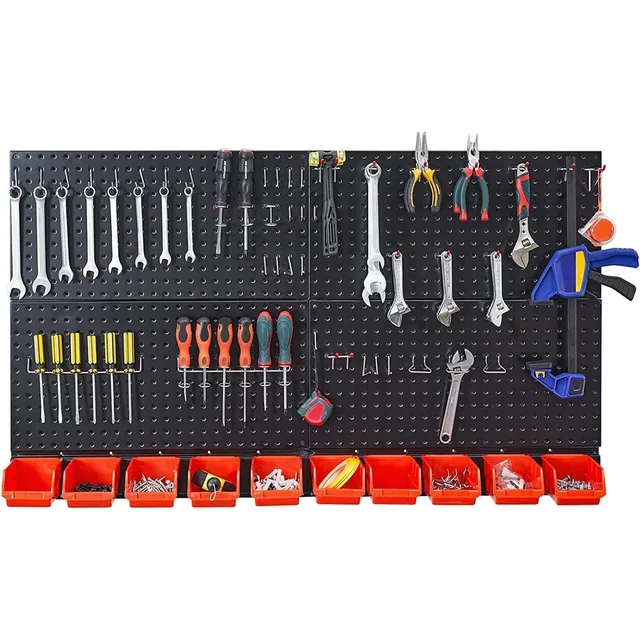
Garages get damp. Cars bring in rain and snow, the door lets in cold air that condenses on cold walls, and some garages share a wall with a laundry. Steel and damp need some care, and the care is mostly in the finish.
Our panels, rails and brackets are powder-coated. The finish resists rust, chipping and cracking, and resists is the right word. A scratch through the coating exposes bare steel, and bare steel rusts. If you scratch a panel while hanging it, a dab of touch-up paint on the bare spot keeps it from spreading.
A scratch through the powder coat shows bare steel. A dab of touch-up paint on it keeps rust from spreading under the coating.
The tools need the same thought. Hang them dry. A wet shovel or a rake fresh from the lawn drips onto the board and the floor, and its own steel rusts on the hook. Let garden tools dry in the sun or wipe them before they go up. Keep a rag on a hook at the end of the board for that purpose, and the board stays clean for years.
Adding and moving panels later
A pegboard wall is never finished. New tools arrive, hobbies change, and a corner that held paint brushes becomes the place for a 3D printer’s spare parts. The steel panel system makes that easy, because each panel stands on its own screws.
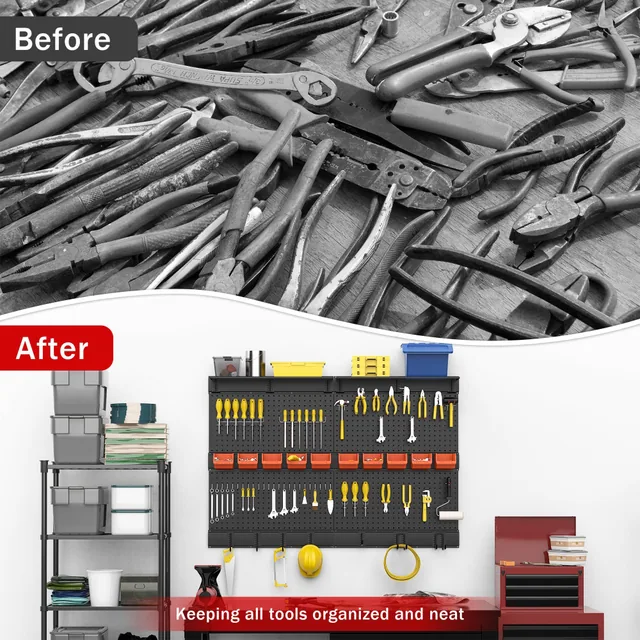
To extend the wall sideways, hang the new panels against the edge of the old ones at the same height, using a level across both. To move a panel, take its hooks off first, then its screws, and fill the old anchor holes in the drywall before you paint. Spare anchors are worth keeping in one of the bins for exactly this.
Buy panels in the same color as the first ones if you want the wall to read as one board. The three-pack in white or gray can also frame a black board, which some people use to set a different zone, such as a painting corner, apart from the rest.
Beyond the garage
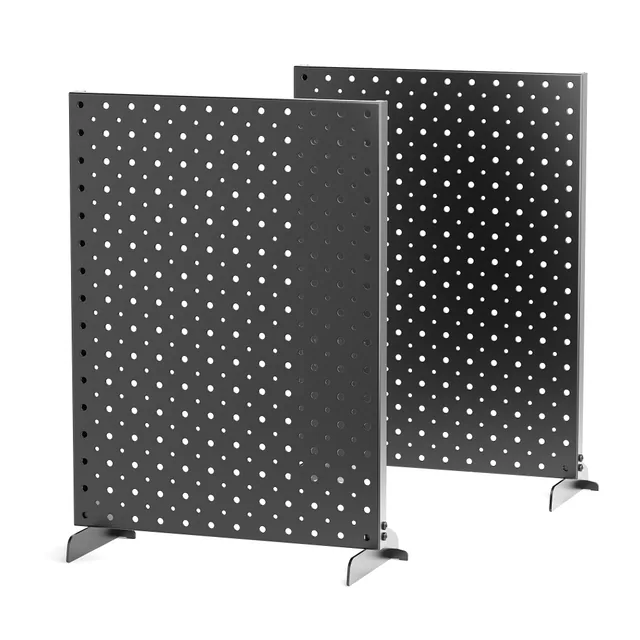
Ultrawall Tabletop Pegboard Display Stand, 12 × 16 in
A 12 by 16 inch steel panel on a wide foot, 11 pounds per stand, for a table or a booth.
Steel pegboard works anywhere you want things on the wall instead of in a drawer. In a kitchen it holds pots and utensils. In a craft room it holds thread, ribbon and scissors. In a laundry room it holds the iron and the lint brushes. The white panels in our three-pack suit those rooms better than black.
We also make a tabletop pegboard stand, a 12 by 16 inch panel on a wide foot, rated to 11 pounds. It is meant for a craft table, a market booth or a bench where you want a few tools upright without drilling anything.
- 3rooms beyond the garage: kitchen, craft room, laundry
- Whitepanels for lighter walls
- 11 lbper tabletop stand
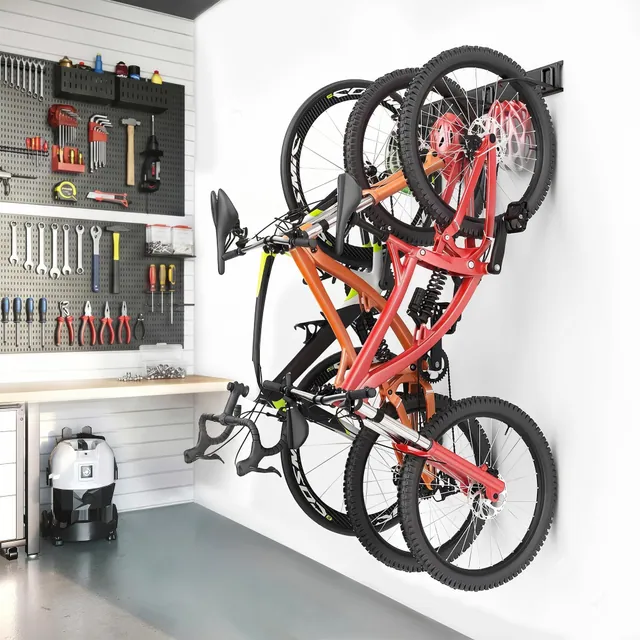
Pegboard also pairs well with the rest of a garage wall. A rail of bike hooks at one end, a pair of folding brackets for a bench below it, and a heavy shelf above the top row of panels turn one stretch of wall into a work corner. Each piece goes up on its own, so the corner can grow in stages as the budget allows.
Before you order
- 5questions before you order
- 1weekend to hang and sort
- 13designs in Pegboard & Bins
Run through five questions and the order almost writes itself. How wide is the wall I can reach from where I work? What kind of wall is it, and what fasteners will it need? Do I already own hooks, and what size are they? Which tools are heavy enough to need a rail or a shelf instead of a hook? Where will the small parts go?
Answer those and you know whether you need plain panels and a hook set, a complete kit, or a mix of pegboard and rail. All of our pegboard, hooks and bins are in one department, and search finds a design by size, by hole size or by the model number on the box.
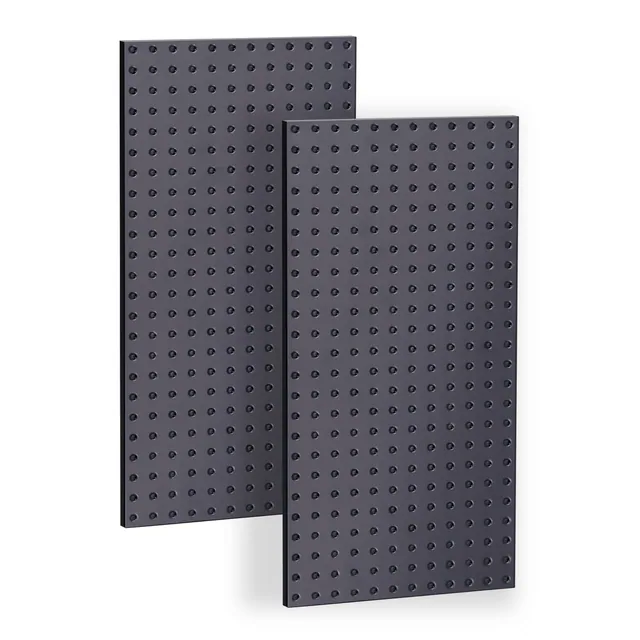
Ultrawall Metal Pegboard Panels, 24 × 12 in
Plain 24 by 12 inch steel panels in packs of two or four, for 1/8 and 1/4 inch hooks.
Then give the wall a weekend: hang the panels in the morning, sort tools in the afternoon, and move hooks around the next day until the layout feels right. After that, the bench stays clear and the tools stay where you left them.