
Ultrawall guide
Garage Bike Storage: Wall Hooks, Swivel Racks, Ceiling or Floor
Where the bikes should go: weigh the bike, match the hook to the tire, and choose between wall rails, swivel and no-lift racks, ceiling tracks, freestanding towers and floor stands.
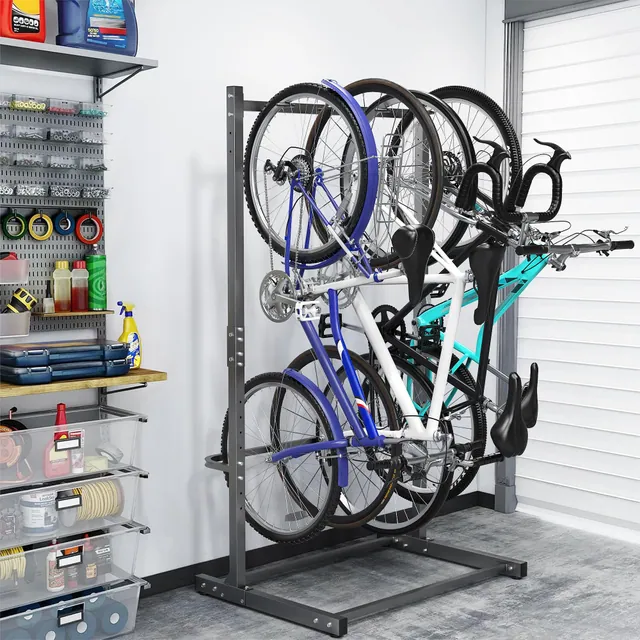
A bike is the most awkward thing in a garage. It is too long to lean anywhere neatly, its pedals catch on everything, and it falls over the moment someone brushes past. Two or three bikes on the floor can take the space of a small car. Hang them up and the same garage parks the car, holds a bench and still has room to walk.
- 12bike designs
- 50–100 lbrating per hook
- 5ways to store a bike
There is no single right way to do it. A rail of hooks on the wall suits a family of light bikes. A swivel rack suits a narrow wall or a heavy bike. A ceiling track suits a garage whose walls are already full. A freestanding tower suits a rental where you cannot drill. A floor stand suits children who ride off every morning and drop the bike on the way back in.
We make all of these, 12 designs in total, and the choice comes down to five things: the bike’s weight, its tires, the wall, the ceiling and who rides it.
Weigh the bike before you choose
Every rack we sell carries a load rating, and it always says what the number covers: per hook, per rail or in total. A rating per hook is the one to compare with your bike. You do not need a special scale to weigh it. Stand on a bathroom scale, note the number, then pick the bike up and stand on it again. The difference is the bike.
- 2.1–4.4 inwidest tires named on our racks
- 2readings on the bathroom scale
- 1number that matters: the bike
Most of our bike hooks are rated between 50 and 100 pounds per hook. The heaviest single rating is on the freestanding tower, at 100 pounds per welded hook. If your bike is close to a rating, pick the rack with more margin. A hook that carries its full rating every day is working harder than one that carries half of it.
Electric bikes deserve a second look. The battery and motor add weight that a plain hook was never asked to carry, and lifting one onto a vertical hook is hard work. For those bikes, a floor stand, a freestanding tower or the no-lift BIKEPAL rack usually makes more sense than a ceiling hook.
Five ways to store a bike, side by side
Here is every bike rack we make: how many bikes it holds, what it is rated to carry, and the widest tire it takes. Check the tire width before the bike count: a fat tire will not sit in a 2.1 inch receiver.
| Point | Design | Mount | Bikes | Rating | Widest tire | Price |
|---|---|---|---|---|---|---|
| Wall Bike Rack | Wall | 2–6 | 300 lb in total | Road and mountain | from $22.99 | |
| Vertical Bike Rack with Helmet Hooks | Wall | 3–6 | 330 lb in total | 4.4 in | from $27.99 | |
| BIKEPAL Swivel Bike Rack | Wall | 2–4 | 77 lb per hook | 2.1 in | from $99.99 | |
| Swivel Bike Storage Rack, 4 Bikes | Wall | 4 | 50 lb per hook | Road and mountain | $44.99 | |
| Swivel Bike Hanger with 3-Position Lock | Wall | 2–4 | 50 lb per hook | 3.1 in | from $35.99 | |
| Horizontal Bike Pedal Hanger | Wall | 2–3 | 70 lb per hook | Road and mountain | from $19.99 | |
| Ceiling Bike Rack with Sliding Track | Ceiling | 6 | 66 lb per hook | Road and mountain | $42.99 | |
| Ceiling Bike Rack, 25 in Rails | Ceiling | 4 | 65 lb per hook | 3.7 in | $39.99 | |
| Freestanding Vertical Bike Stand | Freestanding | 4–6 | 100 lb per hook | Road and mountain | from $119.99 | |
| Freestanding Bike Rack with Wheels | Freestanding | 4–5 | 70 lb per hook | Road and mountain | from $129.99 | |
| Floor Bike Stand | Floor | 3–5 | Pad and straps | 2.1 in | from $42.99 | |
| Tailgate Bike Pad, 62 in | Tailgate | 5 | Pad and straps | Road and mountain | $55.99 |
Read it with your own garage in mind. A wall rack that holds six bikes is no use if the only free wall is behind the car. A ceiling track that holds six is no use if the garage door opener runs down the middle of the ceiling. The next sections take each type in turn, with what it does well and where it falls short.
Wall rails with hooks
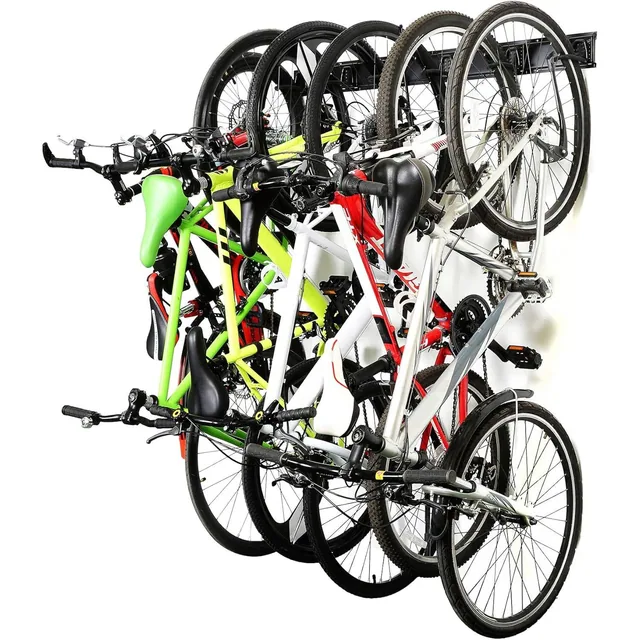
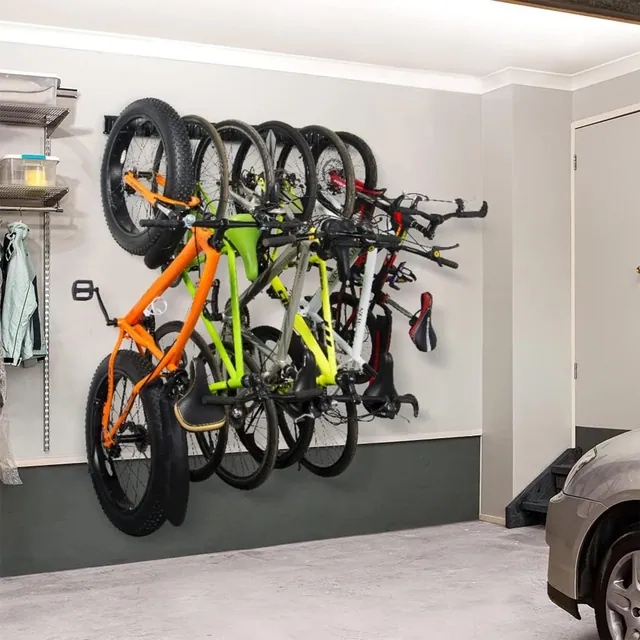
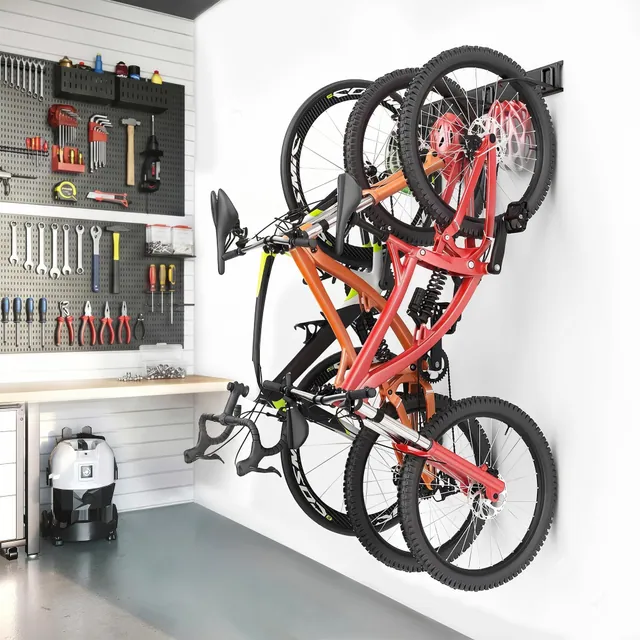
The simplest way to store several bikes is a steel rail on the wall with hooks that hold each bike by its front wheel. The bike hangs vertically, its back wheel against the wall, and takes about as much floor depth as the length of the bike. Our Wall Bike Rack has more buyer ratings than anything else we make. The long version is a 48 inch rail with six hooks, rated to 300 pounds in total.
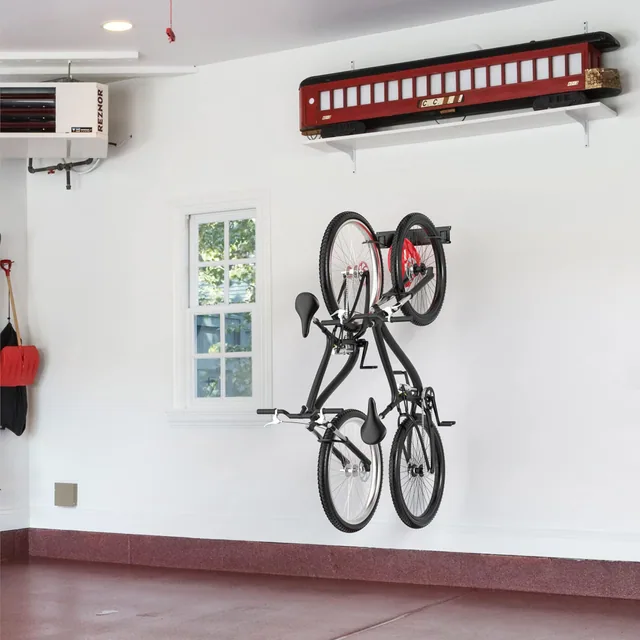
Six hooks on four feet of rail is tight. The rail takes up to six bikes, and we recommend four. Handlebars are wider than the space between hooks, so bikes at full density have to be staggered, one high and one low, or turned so the bars clear each other. Four bikes on the same rail hang straight and come off without a fight.
- 48 inrail on the six-bike rack
- 6hooks, 4 bikes recommended
- 300 lbrating in total
For mountain bikes and fat tires, the Vertical Bike Rack with Helmet Hooks uses larger hooks, 4.6 inches across, that take tires up to 4.4 inches wide. Each rail is rated to 165 pounds, and the set adds helmet hooks between the bike hooks, so the helmet hangs next to the bike it belongs to. Hooks on both racks snap onto the rail and slide sideways, so you can space them for the bikes you own today and move them when a child moves up a size.
The rubber coating on the hooks is there to protect the rims from scratches, and it grips the wheel so the bike does not slide on the hook.
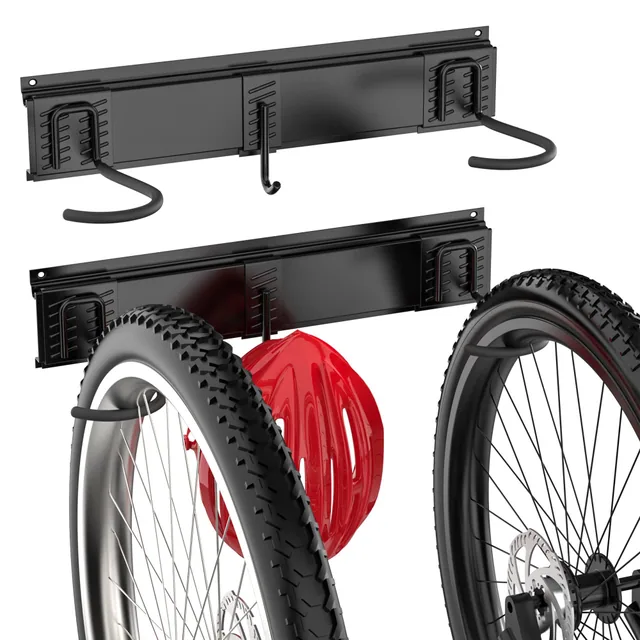
Ultrawall Wall Bike Rack
A 48 inch rail for up to six bikes, or a two-bike rack with a helmet hook, from $22.99.
Swivel racks for narrow walls and heavy bikes
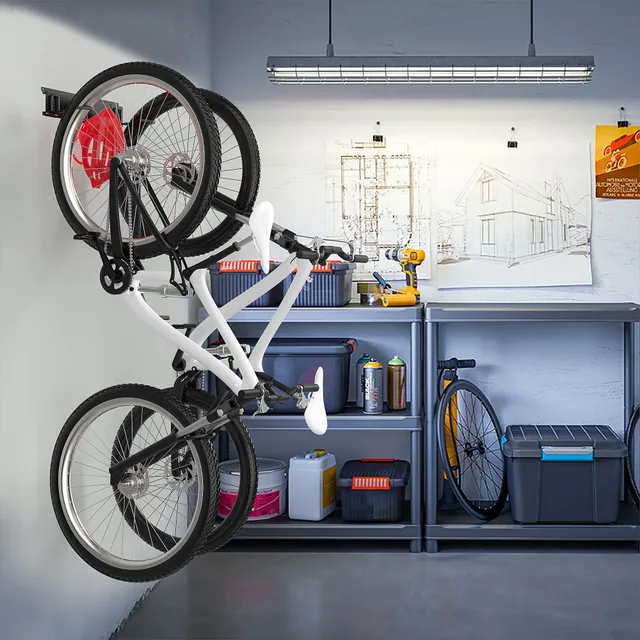
A bike hanging straight out from the wall sticks out by its full length. In a narrow garage that is the space the car door needs. A swivel rack solves this by letting the bike turn sideways, almost flat against the wall, once it is hung.
Our Swivel Bike Storage Rack, 4 Bikes puts four hooks on four 16 inch rails, and each hook turns through 130 degrees. Hang the bike, swing it to one side, and the next bike can hang beside it with its handlebars overlapping the first.
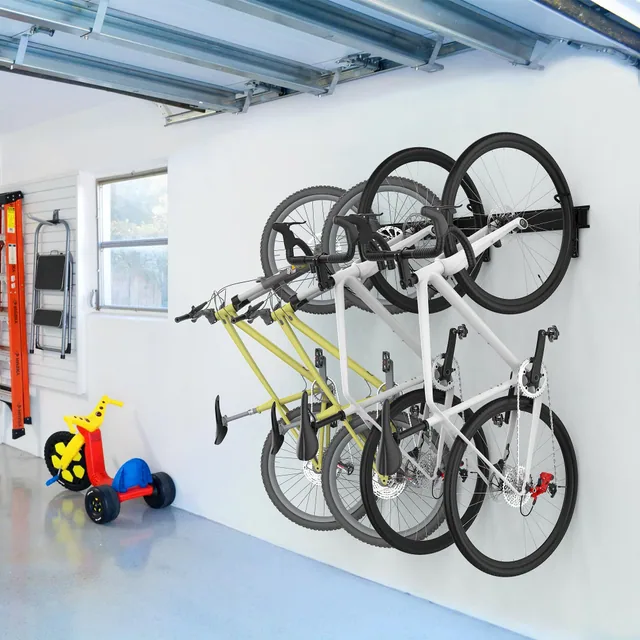
The Swivel Bike Hanger with 3-Position Lock swings 60 degrees each way and locks in the left, center or right position. With no bike on it, it locks itself in the center so the empty hook does not swing into your shoulder. It takes tires up to 3.1 inches wide and is rated to 50 pounds per hook.
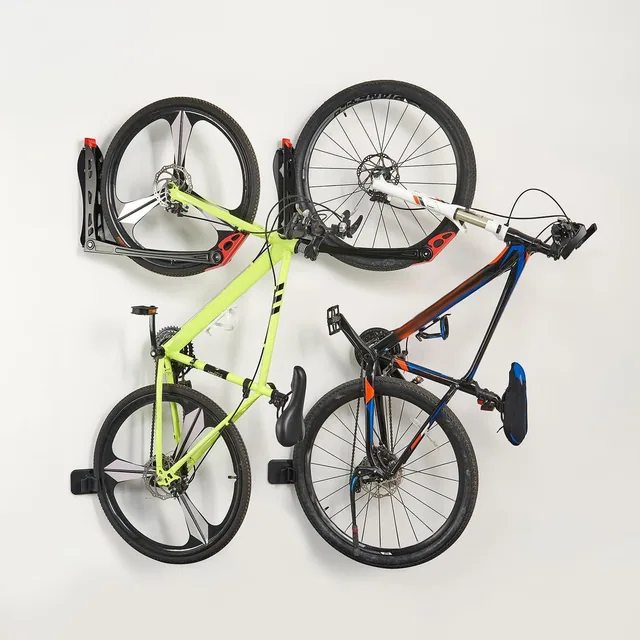
The BIKEPAL rack goes further and removes the lift altogether. You balance the bike on its back wheel, roll it up to the wall and push the front wheel into the receiver. The arm pivots, the bike folds flat against the wall, and the back wheel rests in a plastic tray that keeps the tire off the paint. It fits wheels from 20 to 28 inches and tires up to 2.1 inches wide, and each hook is rated to 77 pounds.
If anyone in the house finds lifting a bike onto a hook at head height difficult, the no-lift design is the one to choose. It costs more per bike than a plain hook, and it does not take fat tires.
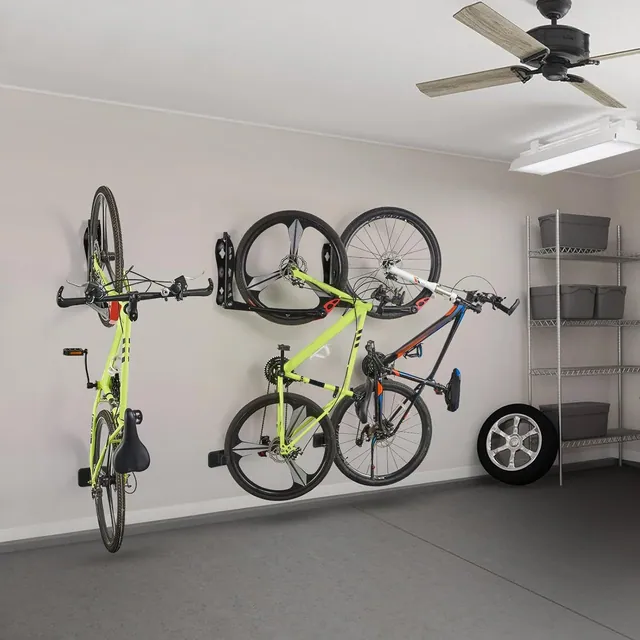
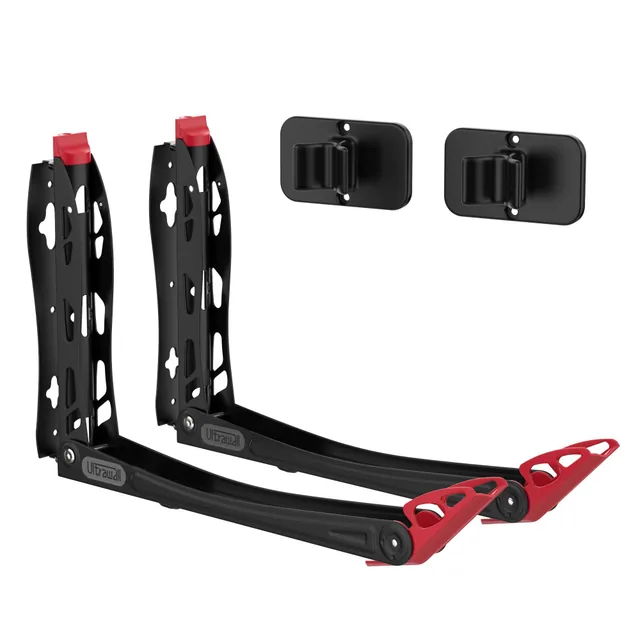
Ultrawall BIKEPAL Swivel Bike Rack
Roll the back wheel in and push: no lifting, 77 pounds per hook, for wheels from 20 to 28 inches.
Horizontal hangers: the bike as a picture
Some bikes are too good to hang by a wheel. A road bike with a painted frame can sit horizontally on the wall instead, like a picture, held by the pedal and the tire. Our Horizontal Bike Pedal Hanger does exactly that. It holds the bike by its pedal and tire to keep stress off the frame, it is rated to 70 pounds, and it comes in two-bike and three-bike sets.
A horizontal bike takes more wall width than a vertical one, about the length of the bike, and less depth. It suits a hallway, a home office or a garage wall above a bench. It holds the bike by a pedal, so check that your pedals have a flat platform.
Ceiling tracks: when the walls are full
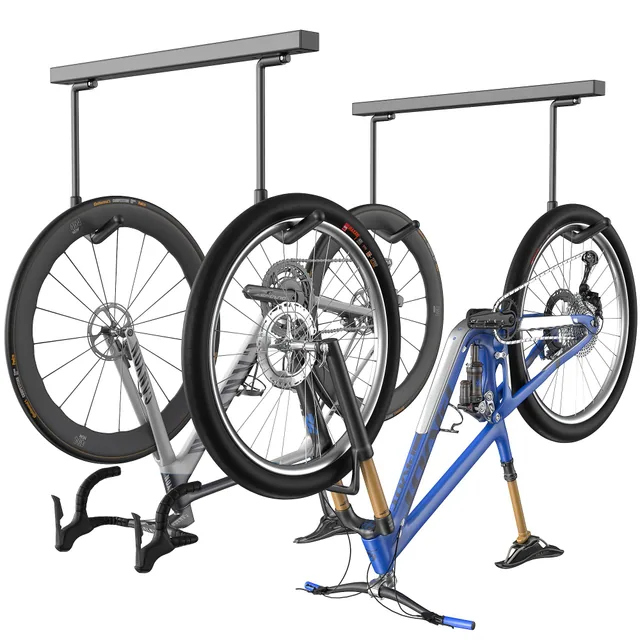
A garage ceiling is the largest empty surface in the house. Bikes stored there leave the walls for tools and shelves and the floor for the car. The cost is the lift: you raise the bike over your head to hang it, and you need a ceiling high enough that the hanging bike clears whatever parks beneath it.
- 66 lbper hook on the ceiling track
- 16 or 24 injoist spacing for the 25 in rails
- 3 or 6bikes, level or vertical
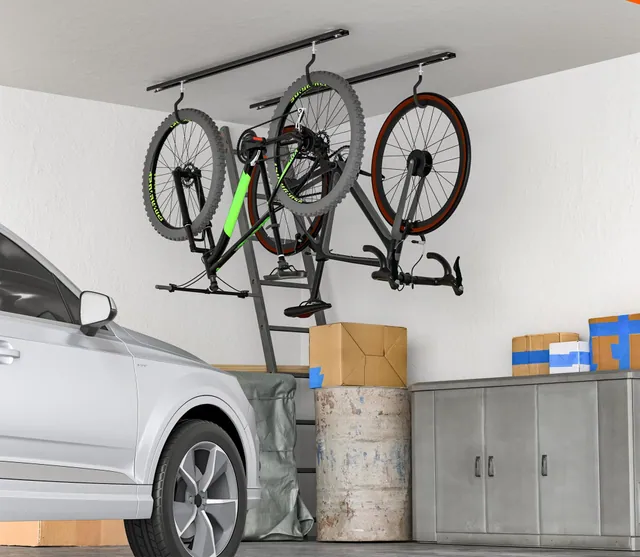
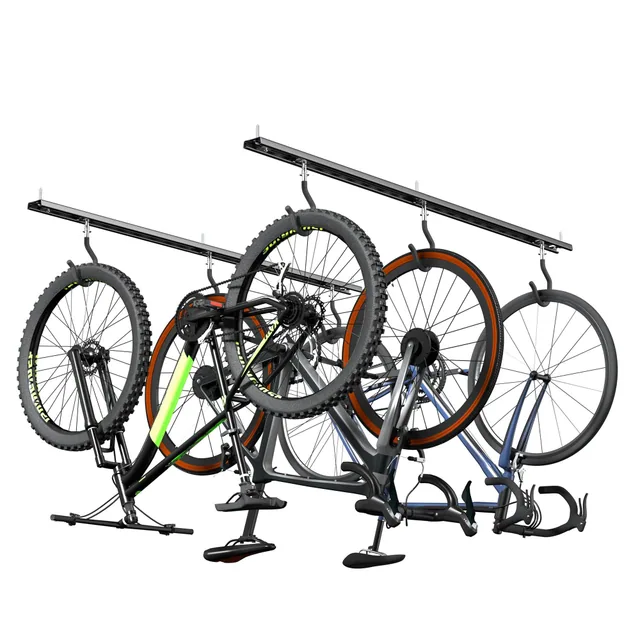
The Ceiling Bike Rack with Sliding Track hangs six rubber-coated hooks from a track, each rated to 66 pounds. Three bikes can hang level, held by both wheels, or six can hang vertically by one wheel, and the hooks slide along the track to fit. The Ceiling Bike Rack, 25 in Rails is shorter: two 25 inch rails that hold two bikes level or four vertically, 65 pounds per hook, with room for tires up to 3.7 inches wide.
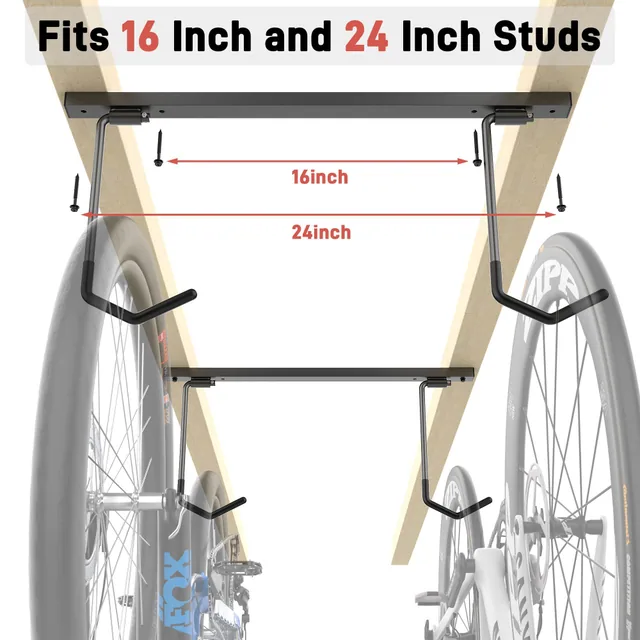
Both screw into the ceiling joists, not into the drywall between them. The 25 inch rails are made for joists 16 or 24 inches apart. Find the joists with a stud finder, mark them, and check that nothing else uses that ceiling: a garage door track, an opener rail, a light fixture. Then measure from the ceiling down to the roof of the car. A bike hanging vertically by one wheel drops about its own length below the hook.
Level hanging is kinder to low ceilings, because the bike takes only the height of its wheels below the track. Vertical hanging fits more bikes into less ceiling, but each bike drops much lower. In a garage with a low ceiling and a tall vehicle, hang level.
Ultrawall Ceiling Bike Rack with Sliding Track
Six sliding hooks on a ceiling track: three bikes level or six vertical, 66 pounds per hook.
No drilling: towers and floor stands
Renters, people with finished walls they do not want to drill, and anyone whose garage walls are concrete have the same problem. The answer is a stand that carries the bikes on its own frame.
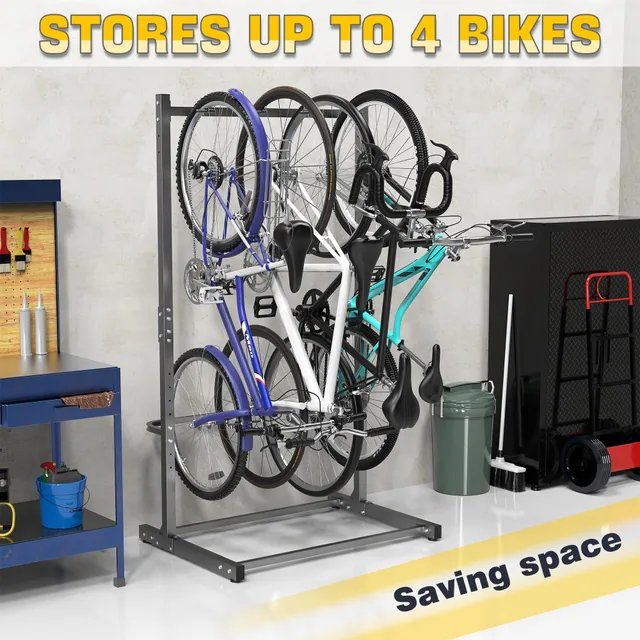
The Freestanding Vertical Bike Stand is a steel tower that holds four, five or six bikes vertically, with welded hooks rated to 100 pounds each. The four-bike version stands 81 inches tall, so check the height of a garage door opening or a low beam before you assemble it there. The Freestanding Bike Rack with Wheels adds four wheels and four foot pads, so it rolls out of the way and then stands still. Its hooks are rated to 70 pounds each.
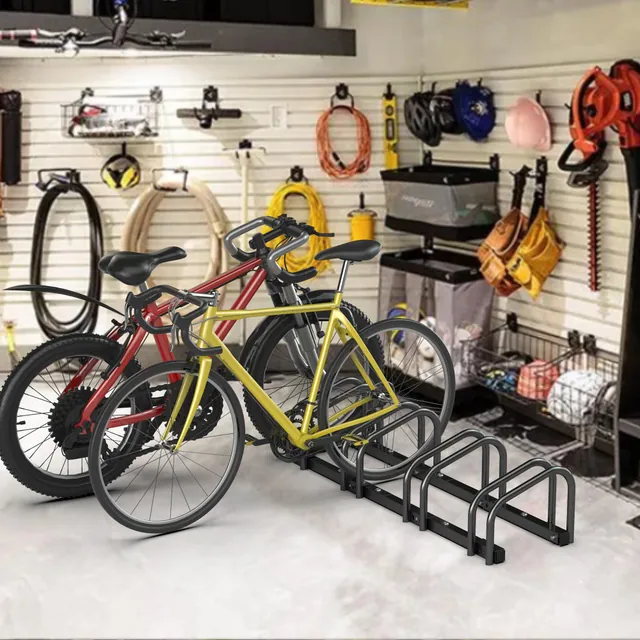
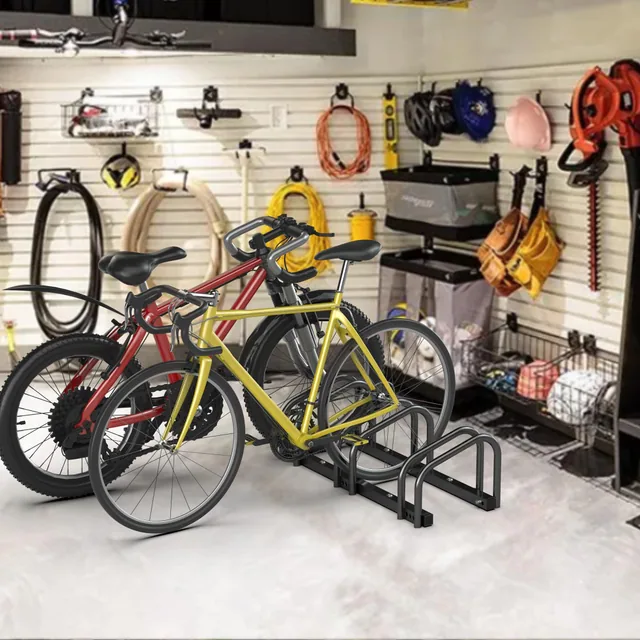
Floor stands are the simplest of all. Our Floor Bike Stand holds three, four or five bikes by one wheel each. Roll the wheel into a slot and walk away. It fits wheels from 22 to 28 inches and tires up to 2.1 inches wide, and it can be screwed to the floor if you want it fixed. Bikes can stand alternated, one facing in and the next facing out, which lets wider handlebars pass each other.
A floor stand is the right choice for children. A young child cannot lift a bike onto a hook, but can roll it into a slot. It also keeps the bikes upright, which means fewer scratched cars from bikes leaning against them.
Tires, wheels and which hook fits
Hooks are sized for tires, and tires vary more than people expect. A road bike tire may be about an inch wide. A mountain bike tire is often well over two. A fat-tire bike can run tires close to five inches. A hook too narrow for the tire will not take the bike at all, and a hook far too wide lets a thin wheel twist.
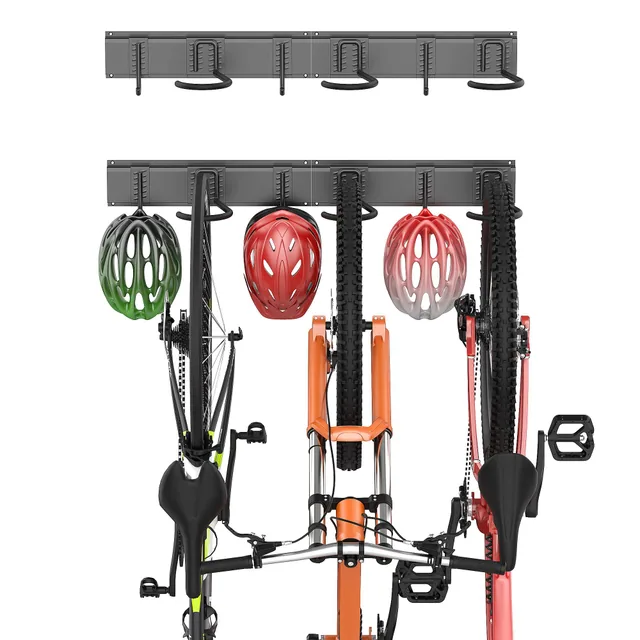
Ultrawall Vertical Bike Rack with Helmet Hooks
Hooks 4.6 inches wide for tires up to 4.4 inches, with a helmet hook beside each bike.
The widest tire each design takes:
- the Vertical Bike Rack with Helmet Hooks takes tires up to 4.4 inches
- the Ceiling Bike Rack, 25 in Rails takes tires up to 3.7 inches
- the Swivel Bike Hanger with 3-Position Lock takes tires up to 3.1 inches
- the BIKEPAL Swivel Bike Rack takes tires up to 2.1 inches
- the Floor Bike Stand takes tires up to 2.1 inches
Measure your tire across its widest point before you choose, or read the size printed on the sidewall. On a tire marked 27.5 x 2.4, the second number is the width in inches.
- 4.4 inwidest tire on the vertical rack hooks
- 3.7 inon the 25 in ceiling rails
- 2.1 inin the BIKEPAL receiver and floor stand
Wheel diameter matters for the designs that hold the wheel in a cradle rather than on a hook. The BIKEPAL receiver takes wheels from 20 to 28 inches, and the floor stand takes 22 to 28 inches. A small child’s bike with 16 inch wheels needs a hook, not a cradle.
Planning a family bike wall
Start by counting bikes, then add one. Families gain bikes faster than they lose them, and a wall planned for exactly today’s bikes is full the day someone gets a new one. A rail system makes that easy, because hooks can be added to an existing rail.
Next, decide who hangs which bike. Adults can lift a bike onto a hook at head height. Children cannot, and their bikes belong low on the wall, in a floor stand or on a no-lift rack. Put the bike used every day nearest the door and the one used in summer only at the far end or on the ceiling.
- +1bike to plan for beyond today
- 2hook heights: adults high, children low
- 4extras to place: helmets, pump, lights, lock
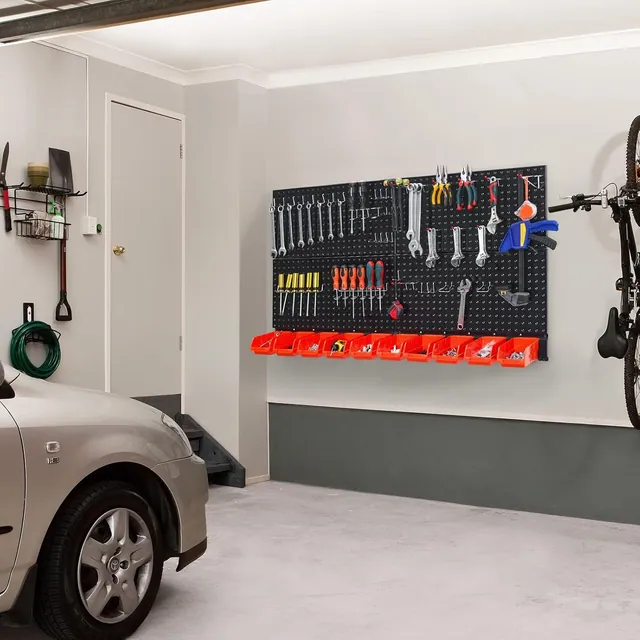
Then plan the extras. Helmets, a pump, lights and a lock all live near the bikes, and they end up on the floor if they have no place. The vertical rack with helmet hooks puts a helmet hook beside each bike hook. A strip of pegboard or a small rail beside the bike wall takes the rest. If the garage has a pegboard wall already, hang the bikes at one end of it and give the accessories the nearest panel.
Finally, think about the car. Measure from the wall to where the car door opens fully, and keep the bikes inside that line. If the bikes stick out further than that, a swivel rack or a ceiling track will give the space back.
How much wall each bike takes
- 8 inbetween six hooks on a 48 in rail
- 12 inbetween four hooks
- 130°swing of the swivel hooks
A vertical bike is narrow at the wheel and wide at the handlebars, and the handlebars decide the spacing. On our 48 inch rail, six hooks sit about 8 inches apart, center to center. Handlebars are far wider than that.
So six bikes only fit if they alternate, one hung with the bars high and the next with the bars low, or if some bars are turned. That is why we recommend four bikes: four hooks on the same rail sit about 12 inches apart, and the bikes come off without unhooking a neighbor.
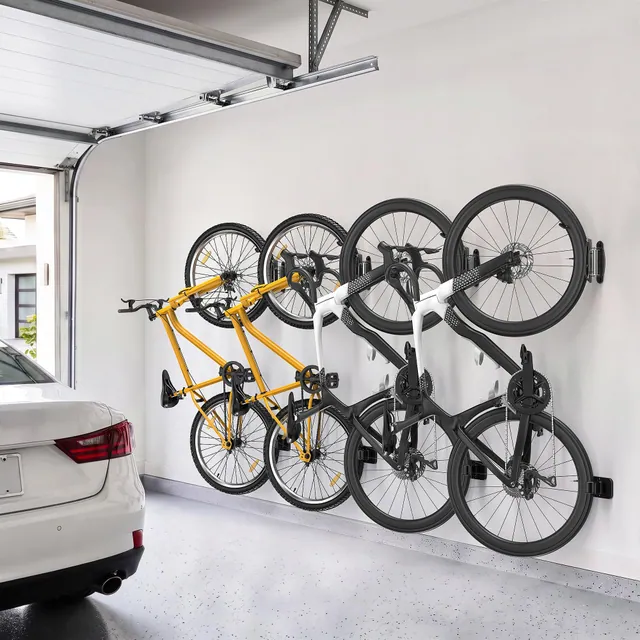
Swivel racks change the arithmetic. A bike swung flat against the wall takes only its own width in depth, but it takes most of its own length along the wall. The four-bike swivel rack comes with four separate 16 inch rails for that reason: you place them where the bikes want to be, not where a single rail dictates.
Ceiling tracks follow the same logic in the other direction. Three bikes hung level need the length of three bikes along the track. Six hung vertically need far less track, but they need the ceiling height to hang a whole bike.
Cost per bike
Price per bike is a fair way to compare designs that hold different numbers of bikes. The table divides the current price of each design’s largest version by the number of bikes that version holds. It changes when the prices do.
| Point | Design | Largest version | Price | Per bike |
|---|---|---|---|---|
| Wall Bike Rack | 6 bikes | $35.99 | $6.00 | |
| Ceiling Bike Rack with Sliding Track | 6 bikes | $42.99 | $7.17 | |
| Horizontal Bike Pedal Hanger | 3 bikes | $22.99 | $7.66 | |
| Vertical Bike Rack with Helmet Hooks | 6 bikes | $45.99 | $7.67 | |
| Ceiling Bike Rack, 25 in Rails | 4 bikes | $39.99 | $10.00 | |
| Tailgate Bike Pad, 62 in | 5 bikes | $55.99 | $11.20 | |
| Swivel Bike Storage Rack, 4 Bikes | 4 bikes | $44.99 | $11.25 | |
| Swivel Bike Hanger with 3-Position Lock | 4 bikes | $55.99 | $14.00 | |
| Floor Bike Stand | 5 bikes | $69.99 | $14.00 | |
| Freestanding Vertical Bike Stand | 6 bikes | $119.99 | $20.00 | |
| Freestanding Bike Rack with Wheels | 5 bikes | $139.99 | $28.00 | |
| BIKEPAL Swivel Bike Rack | 4 bikes | $189.99 | $47.50 |
Simple wall rails come out cheapest per bike, and no-lift and freestanding designs cost more, because they carry more steel and do more of the work for you. The cheapest rack per bike is not always the cheapest choice overall. If a cheaper rack means lifting a heavy bike over your head every evening, the bike will end up leaning against the wall again.
Bikes in the off-season
Many households ride from spring to autumn and park the bikes for the winter. Those months are the best argument for the ceiling. A bike that will not move until April does not need to sit at arm’s reach, and it frees the wall for the snow shovel and the winter gear.
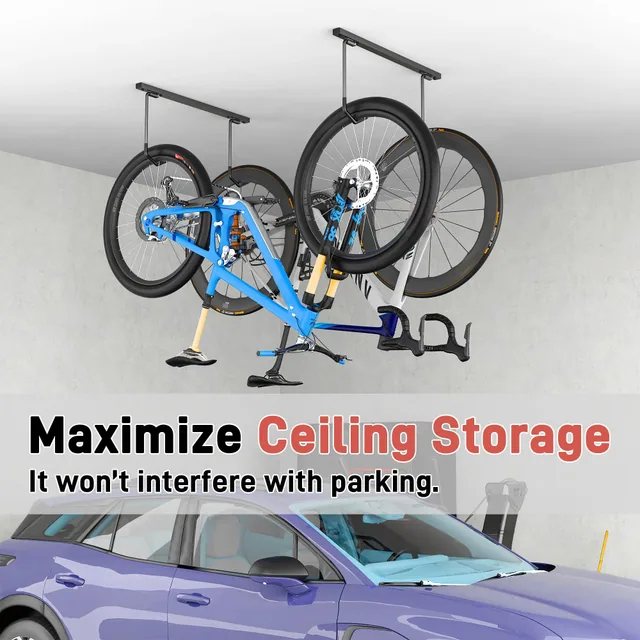
Before a bike goes up for the season, clean it, let it dry, and wipe the chain. Garages are damp in winter, and a wet chain stored for months is a rusty chain in spring. Hang the bike, then forget it until the weather turns. When it comes down, check the tire pressure before the first ride, because tires lose air while they hang.
If the ceiling is not an option, the far end of a wall rail works just as well. Put the summer bikes at the end furthest from the door and the bikes that still get used, perhaps a commuter bike or a child’s bike for the weekend, nearest the door.
Mounting a bike rack to the wall
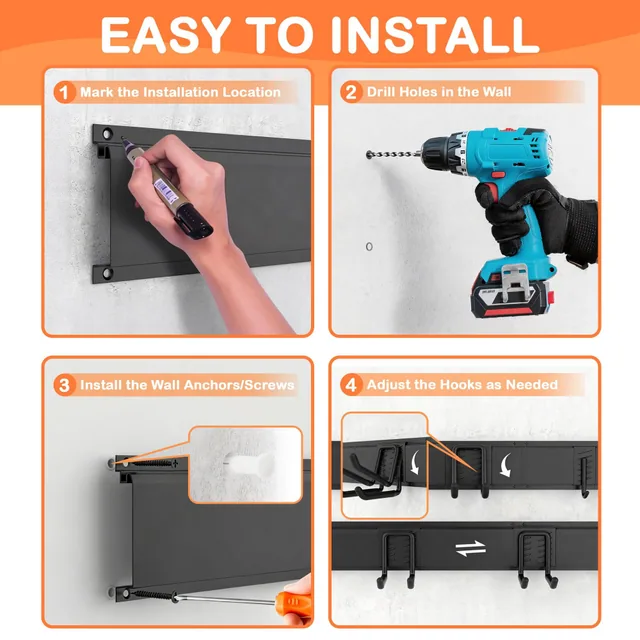
Bike racks pull outward from the wall as well as down, because the bike’s weight sits away from the rail. That is why the fastening matters more than for a shelf. Screw rails into studs wherever you can. The six-bike rail goes up with a 5 mm drill bit and comes with 16 screws and 16 expansion tubes for wood stud, drywall, concrete or brick walls.
- 5 mmdrill bit for the six-bike rail
- 16screws and 16 anchors in that box
- 3screws per BIKEPAL rack
Mark the studs before you lift anything. Hold the rail level at the height where the hooks will hold each wheel with the back wheel just off the floor, or resting on it, as you prefer. Mark the holes, drill, set anchors where there is no stud, and screw the rail on. Snap the hooks on last, hang one bike, and check the spacing before you hang the rest.
Swivel racks and single hooks screw on one at a time. The BIKEPAL rack needs only three screws into a stud. Their positions decide the spacing, so hang the first two bikes, check that the handlebars clear each other when swung, and only then fit the rest.
Use the fasteners each rack’s instructions name, into studs, joists or masonry, and keep each hook within its rating. A rack is only as strong as what holds it to the wall.
Checking a bike rack once a season
A bike rack is not a set-and-forget thing. Every time a bike goes on and off, the hook takes a small knock, and over a year the screws can work loose in drywall anchors. A five-minute check at the start of each season keeps the rack sound.
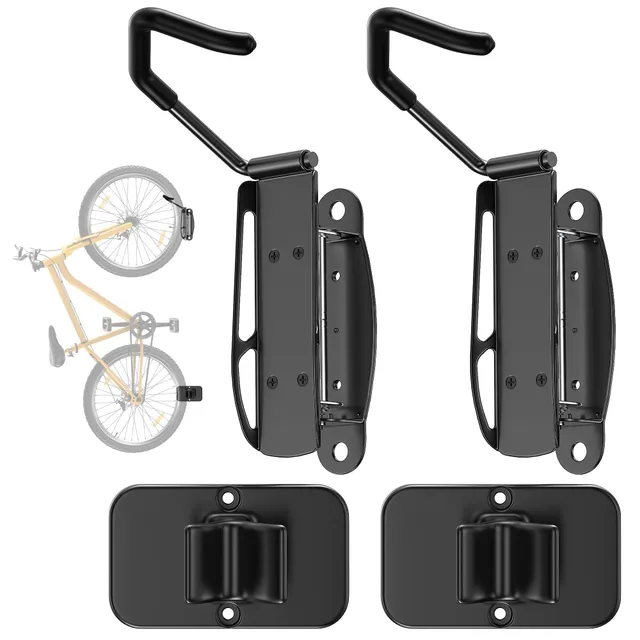
Ultrawall Swivel Bike Hanger with 3-Position Lock
A hook that swings 60° each way and locks itself in the center when empty.
Take the bikes off. Pull on each hook and on the rail with your hand: nothing should move. Tighten any screw that turns, and replace any anchor that spins in its hole with a larger anchor or, better, move that fixing to a stud. Look at the rubber on each hook, because worn rubber exposes steel that will mark the next rim. On swivel racks, swing each arm through its full range and listen for grinding.
Kids’ bikes as children grow
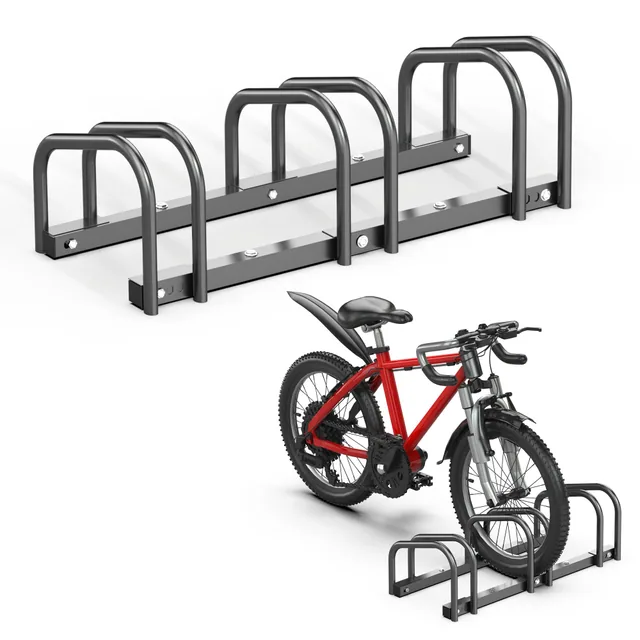
Ultrawall Floor Bike Stand
Roll a wheel in and walk away: 3, 4 or 5 bikes, wheels from 22 to 28 inches.
Children change bikes every couple of years, and each new bike is longer, heavier and has larger wheels. A storage plan that works for a balance bike fails for a 24 inch mountain bike. Rails with sliding hooks cope best, because the hook moves with the bike. Floor stands cope as long as the wheel fits the cradle, which on ours means 22 inches and up.
Teach the habit early. A child who rolls the bike into a floor stand every day keeps doing it, and the bike stays upright, out of the car’s way and out of the rain. A low hook that a child can reach does the same job once they are tall enough to lift the front wheel onto it.
Taking the bikes to the trail
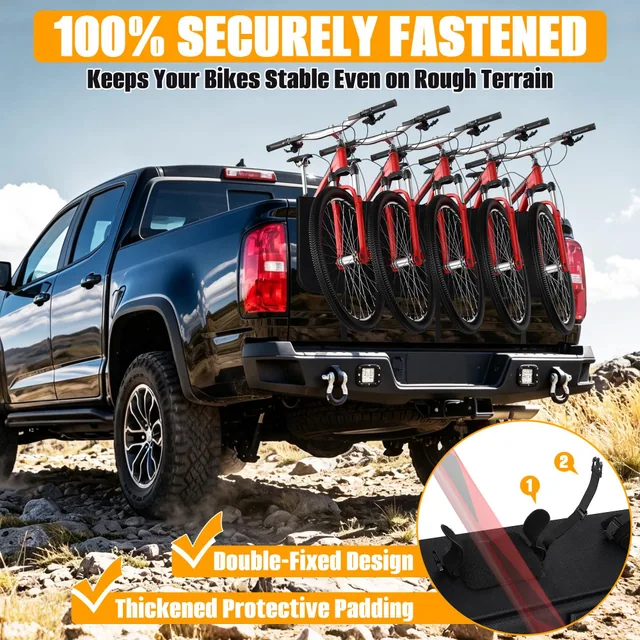
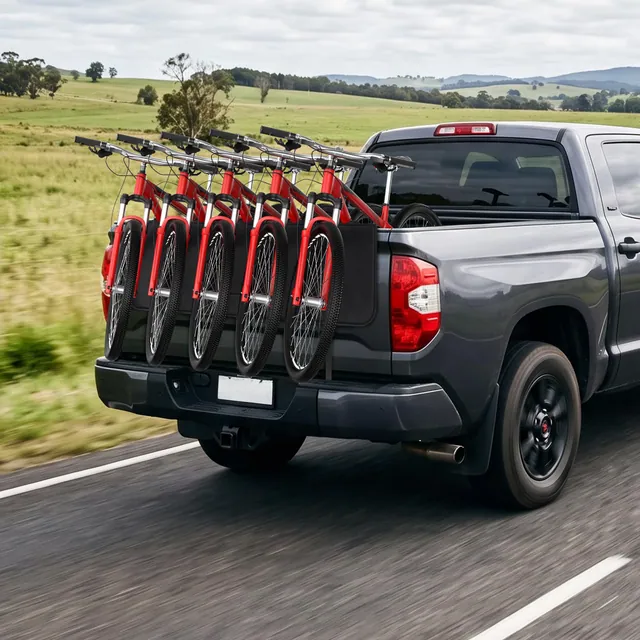
Storage is half the story. The other half is getting several bikes somewhere else. For pickup owners, the Tailgate Bike Pad, 62 in covers the tailgate with padded 900D fabric and holds up to five bikes by their front wheels over the edge. Three long straps hold it to the tailgate, a large cutout leaves the handle and the backup camera clear, and two pockets carry tools.
It is cut for most full-size pickups, and it goes on and comes off in a minute, so it does not live on the truck between rides. Strap each bike frame to the pad before you drive, and check the straps after the first few miles.
Sharing the garage with the car
Most bike walls share the room with a car, and the car decides more than the bikes do. Before you mark a stud, park the car where it usually stands and open the driver’s door all the way. The wall behind that door is not a bike wall. A handlebar that sticks out will meet the door edge, and a pedal will meet the paint.
A vertical hook leaves the bike sticking out about its own length from the wall, so it needs a free bay in front of the bumper or along the side nobody opens. Horizontal pedal hangers and swivel hooks keep the bike parallel to the wall, and that is what you want when the car parks close to it.
- Door sidekeep it free of bikes
- Bumperlowest wheel above it
- Flatpedal hangers and swivel hooks
Think about the car on the move, too. A bike that hangs where a mirror passes will get hit sooner or later. Keep the lowest wheel above bumper height if the bikes hang in front of the car, and leave room to walk past with a bag in each hand. If that walkway is not there, the ceiling or a tower in a corner is the better place.
Before you order
- 5questions before you order
- 12bike designs to choose from
- 1department: Bike Storage
Five questions settle it. How much does each bike weigh, and what is the rating per hook of the rack I am looking at? How wide are the tires? Which wall or ceiling is free, and is it wood, concrete or brick? Who will hang the bikes, and can they lift them? How many bikes will the household own in two years?
With those answers, the five-way comparison narrows the choice to one or two designs. All of our bike racks sit in Bike Storage, from two-bike rails to six-bike rails. You can also search by tire width, by mount, or by the model number printed on the box.